


https://amzn.eu/d/6cGqObO
🔥🔥🔥🔥🔥🔥
“… It’s Alive!”
Guillermo Del Toro’s Frankenstein has finally released this autumn. A labour of love for the visionary filmmaker, and a movie which has been in the works, at least in the back of his mind, for over 30 years. In fact there may just have been a little piece of Frankenstein in virtually all of his films to date. And finally, with the help of streaming giant Netflix, Del Toro has been able to realise his dream, based of course on writer Mary Shelley’s gothic literary classic Frankenstein; or, The Modern Prometheus – which first published over two hundred years ago in 1818.
The legend of Frankenstein may just be the most adapted story of all time, first appearing on film back in 1910. But the classic and often thought of original was released by Universal Studios in 1931. This version was presented with a friendly warning for viewers, introducing the tale of “A man of science who sought to create a man in his own image, without reckoning on God.” This Universal picture is unquestionably a gothic masterpiece. Directed by Englishman James Whale, it stars Colin Clive as Dr. Henry Frankenstein, and of course Boris Karloff as The Monster.

The film begins with the robbing of a grave by the doctor and his hunchback servant, followed by the accidental theft of an abnormal brain from a medical school. These images and themes were really quite extraordinary for the time. The black & white picture opens with a thoroughly menacing score, and very much takes a look at the morality of the scientist’s work and his playing of God, as explored so thoroughly in Mary Shelley’s original text of course.
The castle’s laboratory set is an iconic cinematic image, and was created wonderfully by Whale and his team, while the film provides the perfect suspense as we are made to wait for Karloff’s magnificent portrayal of The Monster. A dead brain, and a body stitched together from corpses, reanimated by an electrical storm. But the sight is absolutely worth the wait, a true iconic Monster to behold. A captivating image with bolts through his neck, the all-time iconic image in Horror.

Karloff’s performance is captivating. The way he moves is stiff yet awkwardly graceful, while the performance in his eyes is an acting masterclass all in itself. We sympathise for this creation, kept in a dungeon and treated like an animal. We feel his longing for sunlight, his desire for freedom. His violence is shown as a product of his mistreatment, and just a few perfectly crafted scenes is all it takes for us to truly understand how he feels.
We watch as the misunderstood Monster tries to learn what it is like to be human, and observe the clumsy accidental drowning of a little girl who’s kind playfulness first makes him smile for the first time. He is then pursued by a mob of angry townsfolk, and overpowers his creator who also means to destroy him. But the tenderness he has for his father is also played with grace by Karloff as he carries him to refuge, before the mob sets fire to the wooden mill he has sought sanctuary in. Finally, we watch The Monster cry as he is engulfed in fire and crumbling timber.
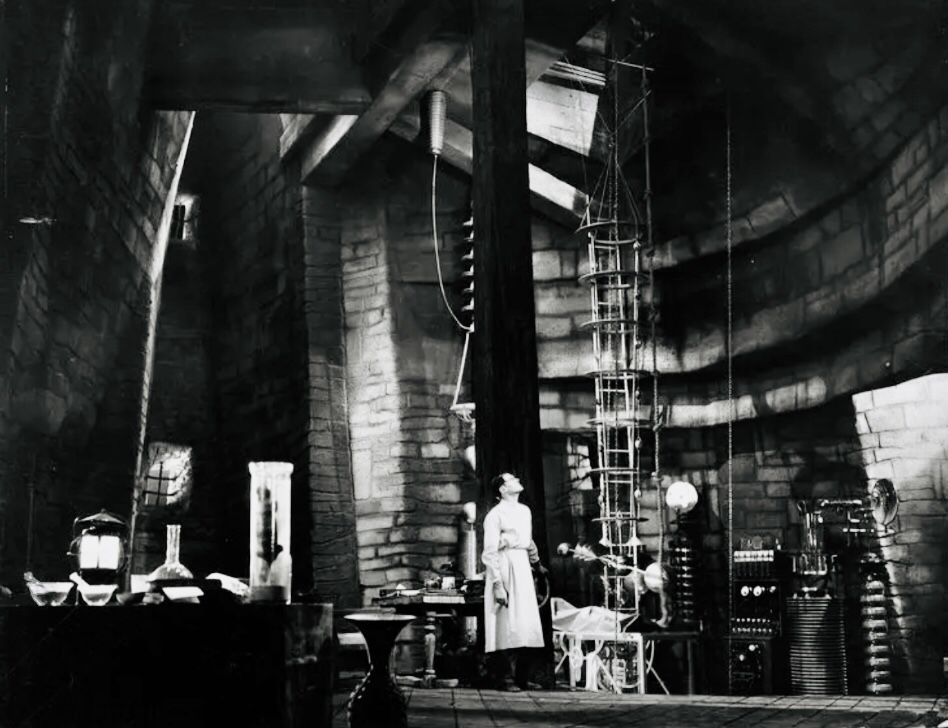
However, ‘The Bride of Frankenstein’ would follow in 1935, providing what would prove to become a common practice in cinema, the Horror movie sequel. Whale opens the film with a beautiful shot of a gothic castle on a dark and stormy night, introducing the legend of Mary Shelley as she converses with Lord Byron about the writing and publication of her infamous story. He then provides a recap of the first film told in exposition, an early example of meta-story telling as Mary Shelley introduces the notion that her tale still has much more to tell.
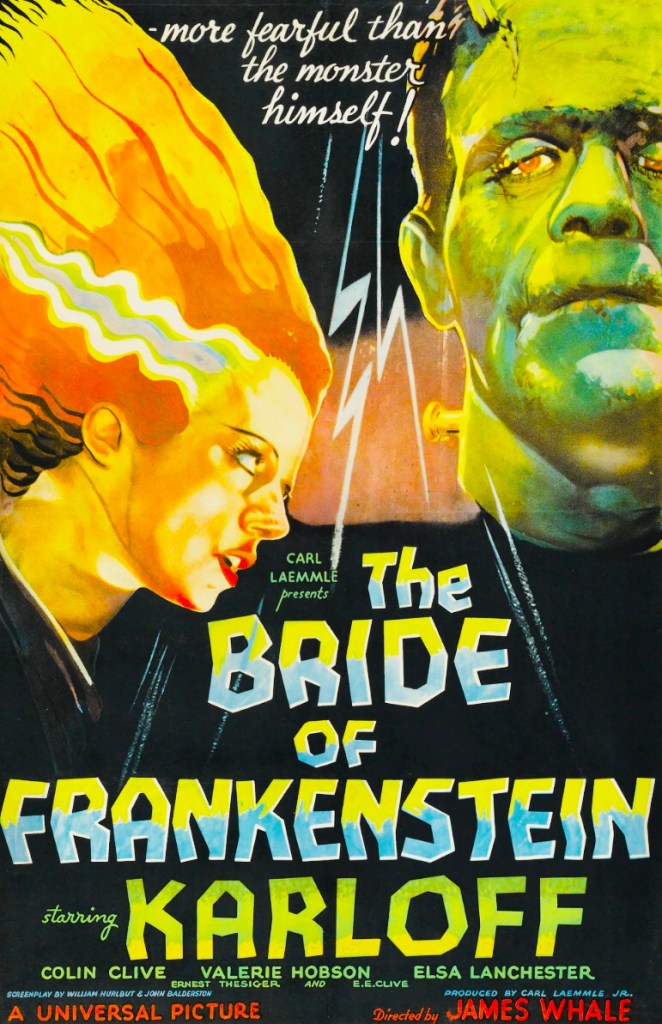
The story then returns to the burning mill we saw at the end of Frankenstein. The Monster has survived, by virtue of the mill’s flooded basement. He drowns a man who ventures inside looking for him in this early scene – the father of the little drowned girl from the first film no less – before also flinging her mother to her doom. With this reintroduction to The Monster, Whale shows us that its soul is now truly lost, while capitalising on the success of Karloff’s portrayal as an iconic figure of Horror.
Henry Frankenstein is recovering from the events of the first film, and he wonders whether “Death is indeed sacred,” while also pondering what may have been, given time and the chance to train his creation. He is visited by his old mentor the mysterious Dr. Pretorius (Ernest Thesiger), who claims that he has also created life. Before he invites Frankenstein to join him in working together on an entirely new creation.

Meanwhile The Monster tries to make sense of the world, unfortunately creating terror wherever he goes given his grotesque appearance and murderous reputation that has spread throughout the area. Travelling through the forest, his anger at the world is soothed by the music of a violin playing blind man (O.P Heggie). Unable to be revolted by his appearance, the blind man offers kindness to The Monster. Kindness he experiences for the first time since meeting the little girl in the first film, and it brings tears to his eyes.
But this encounter is of course doomed to fail, as is the tragedy of The Monster’s existence. When two hunters stumble across the old man’s home, they recognise The Monster, and in the ensuing struggle the old man’s hut is burned to the ground. The Monster finds himself alone once more and in a desperate search for a new friend. Dr. Pretorius takes advantage, and plots to use him to convince Frankenstein that they must together create a companion.
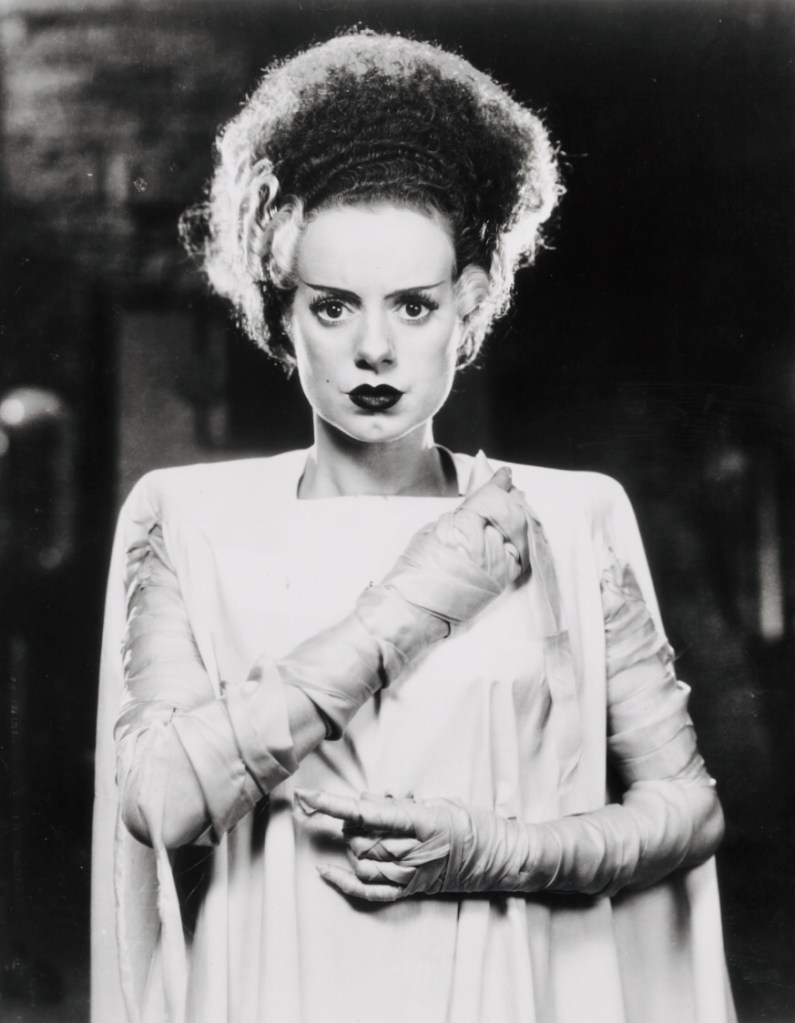
Whale returns the action to a gothic laboratory setting as the two scientists get to work. Producing yet another iconic image of Horror with the carefully cultivated look of The Bride. But sadly for The Monster, even she is repulsed by his appearance. Universal would go on to produce a further six sequels, including the smash cross-over comedy hit Abbott and Costello Meet Frankenstein (1948) – which saw Glenn Strange play The Monster alongside the returning Bela Lugosi as Count Dracula.
But some years later on the other side of the pond over in England, a new revolution in genre film-making would take place courtesy of Hammer Film Productions. And in 1957, they would remake the story of Frankenstein and his creation with The Curse of Frankenstein. Directed by Terence Fisher, Peter Cushing would star in the lead role reverting to Mary Shelley’s original name of Victor Frankenstein. While Christopher Lee, who would play Count Dracula for Hammer the following year, plays The Creature.
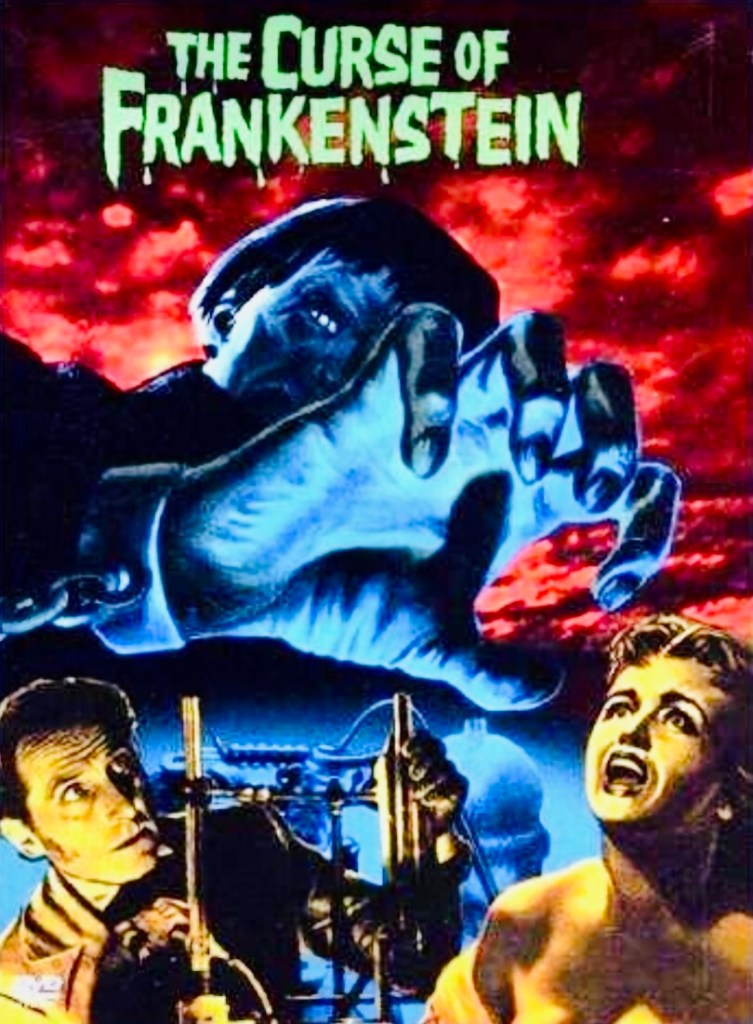
The film presents the story in colour, but retains a wonderful gothic quality as we first meet Frankenstein in a jail cell, before he recounts his life story. As a young man he inherits the Frankenstein fortune following the death of his parents, also inheriting the Baron title. He employs a tutor by the name of Paul Krempe (Robert Urquhart), and the two become great friends, spending many years working together on scientific experiments. Culminating of course, in Frankenstein’s wish to reanimate the dead.
The Curse of Frankenstein certainly has a very different feel to it in comparison with the Universal classics. Hammer had the rights to adapt Mary Shelley’s book, but not to infringe on Universal’s image rights. So the laboratory setting needed to look different, as well as the method of bringing The Creature to life, and the look of The Creature itself. As such, Hammer deliver a very different version of the story in their own unique style, complimented with a highly menacing score throughout.
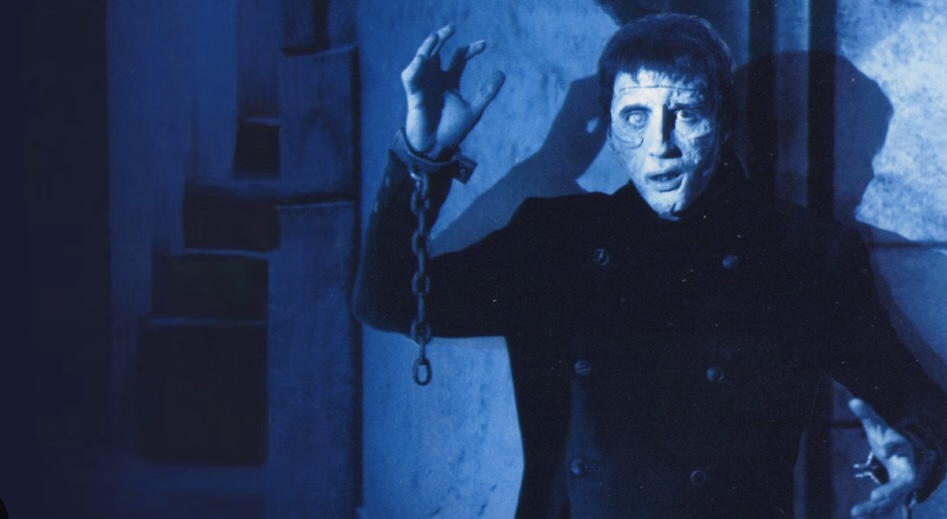
The movie also very much puts the Baron at the centre of the story. Peter Cushing plays Frankenstein as a man obsessed, ultimately a cruel and selfish character who cares little for the life of others, only of his work. Whilst Christopher Lee plays an imposing and terrifying version of The Creature. A darker, animalistic character who adds to the overall Horror of Hammer’s movie. He is instantly violent and evil, unlike the more sympathetic Karloff version. Although in the final act of the film, it is Cushing’s Frankenstein who proves to be the true villain of the story.

Hammer would make five more Frankenstein films, from The Revenge of Frankenstein in 1958 through to Frankenstein and the Monster from Hell in 1974. All with different actors portraying various versions of the scientific experiments. Over the years we would witness the legend seep further into popular culture. Mel Brooks would create the hilarious homage to the Universal movies with Young Frankenstein (1974) starring Gene Wilder, while Hollywood would continue to deliver a host of further Frankenstein inspired movies.
Then, following the success of his epic revisit of the orignal novel with Bram Stoker’s Dracula in 1992, Francis Ford Copolla would spearhead and produce the return of the original Frankenstein story to the big screen. A grounded, faithful adaptation of Shelley’s novel which was written by Frank Darabont (The Shawshank Redemption), and directed by British thespian Kenneth Branagh (Much Ado About Nothing) – who would also star as Victor.
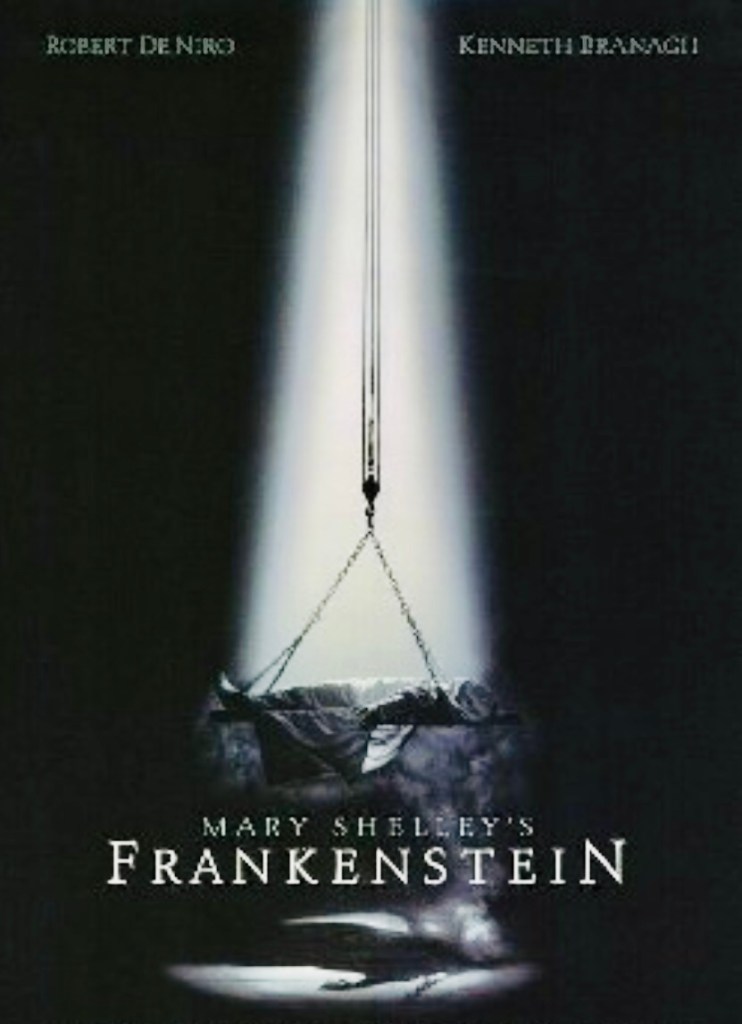
Mary Shelley’s Frankenstein (1994) stayed true to her original text, presenting the film in a way that neither Universal or Hammer had done so before. The film would also notably star the method acting of Robert DeNiro (Taxi Driver) in the role of The Creature, and Helena Bonham Carter (Fight Club) as Victor’s love Elizabeth. This version of Frankenstein uses the electrical current from eels to bring DeNiro’s version of The Creature back to life. But instantly regretting his decision, Victor binds his Monster in chains.
The Creature however manages to escape, where his hideous appearance draws immediate attention from a baying mob. Forced to flee he hides in a cart full of dead bodies, before making an escape into the forest. There, he hides in the barn of a struggling family, learning about humanity by observing their everyday life. Becoming their Spirit of the Forest, as he helps plough their crops in frozen ground while they sleep at night.
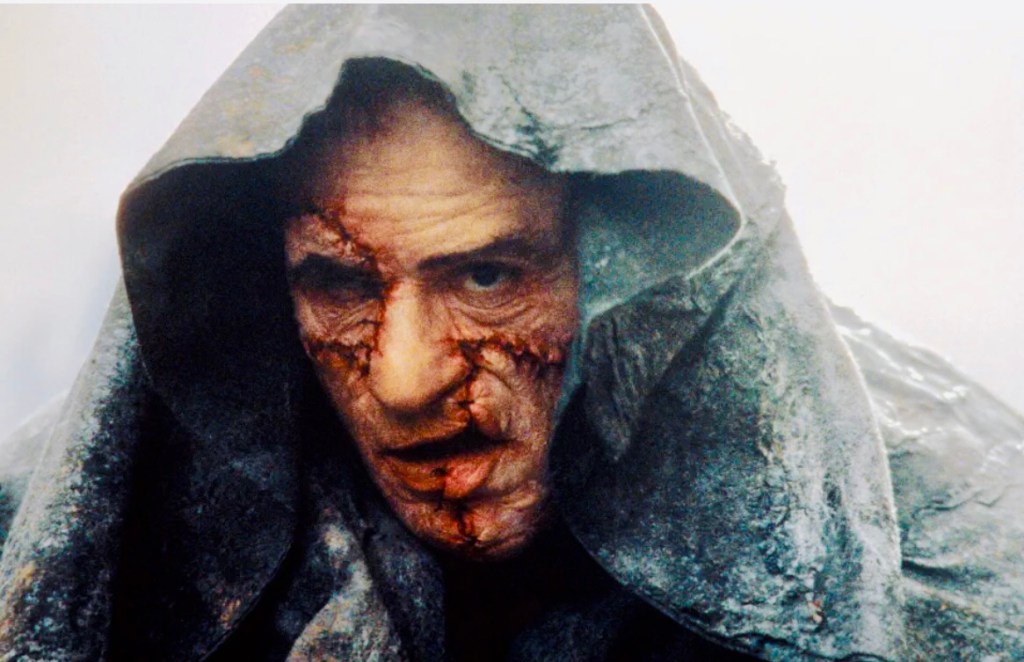
But he is a tragic figure and is eventually shunned when he shows himself, with DeNiro playing an emotionally tortured version of the role. Overcome with loneliness he vows revenge against Victor, and travels to Geneva to look for him where he kills Victor’s younger brother. He then seeks an audience with his creator where he demands answers about his existence, before asking for a female companion so that he may ultimately find love, and not indulge in any further rage.
Branagh plays heavy on the romantic melodrama, and includes a scene where Victor takes Elizabeth to bed on their wedding night, before The Creature literally rips her heart out of her chest. In desperation Victor takes the body of Elizabeth to his lab in order to bring her back to life, This transpires to have been The Creature’s plan all along, for he wants Elizabeth for himself. This film then plays out to a tragic reconciliation for Frankenstein and his creation.

And although the influence of Frankenstein has continued to loom large over Horror cinema, it has now been over 30 years since Branagh delivered his take on the story. And it may just prove to be the perfect time for someone as skilled and passionate as Guillermo Del Toro to revisit and bring forth the story for an entirely new generation. Del Toro has created a further faithful adaptation of the original text, a remake of sorts to Branagh’s, while also adding his own unique touch and greatly expanding the world in which the story operates.
It’s prelude opens in the far north in 1857 where an exploratory Russian ship is moored, trapped in ice. That night, the crew spot a fire on the horizon, and on investigating its source find an injured man virtually at deaths door. They hear the blood curdling roar of a mysterious creature, then shoot their guns as it approaches, causing no damage. “Bring him to me!” The Creature demands after boarding the ship, pointing at the injured man who is of course Victor Frankenstein (Oscar Isaac – Ex Machina).

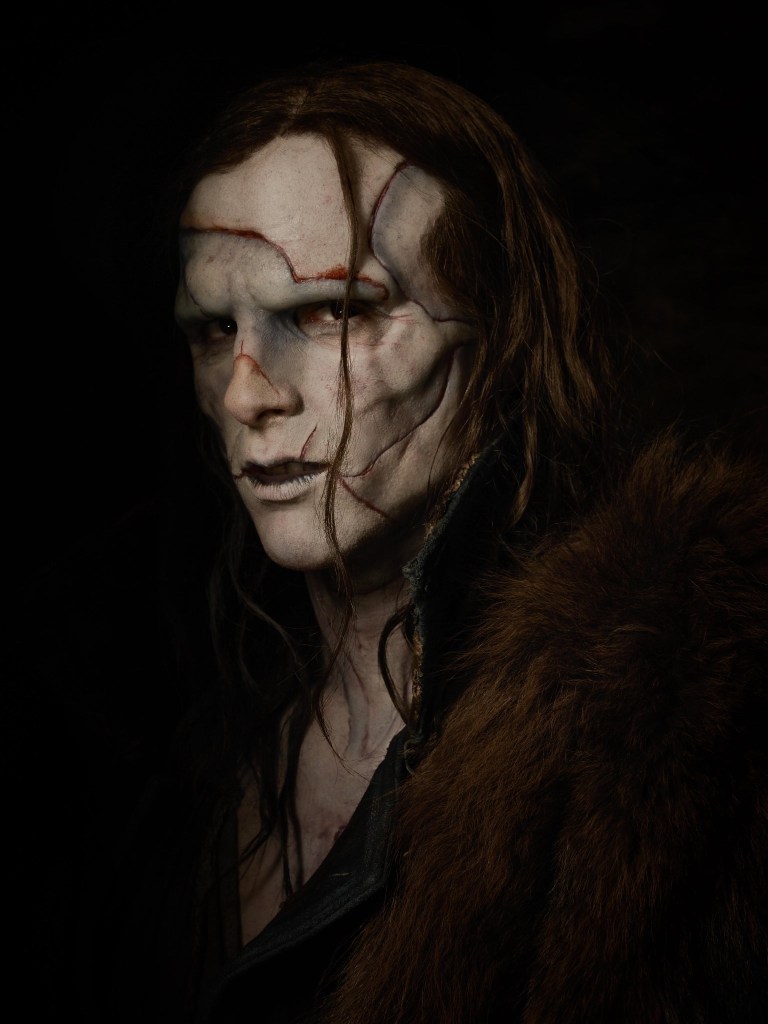
The Creature (Jacob Elordi – Saltburn) is seemingly shot dead, thrown from the ship. But it rises again, its skeletal fingers twitching in the blood soaked snow. This opening sequence is shot fantasically, and it goes without saying that Guillermo Del Toro delivers an absolute visual splendour, as we have come to expect from the director of Pan’s Labyrinth (2006) and Crimson Peak (2015). Frankenstein warns the ships captain that The Creature cannot be killed, and the only way to stop it slaughtering his crew will be to deliver him to it.
We then flashback to Victor’s privileged upbringing in an excessively grand house, the son of an often cruel Swiss nobleman who is played exquisitely as always by Charles Dance (Game of Thrones). The rich period detail in Del Toro’s world building of the era is also exquisite, and there is a sense in these early stages of the film that this may just be the definitive adaptation of Mary Shelley’s work. When Victor’s mother passes away in childbirth, his world is turned upside down. He blames his father for her death, which ultimately proves to be the catalyst for his lifelong obsession with playing God.

The Frankenstein family lose much of their wealth during a depressive period, and when his father passes, Victor relocates, settling in Edinburgh where he builds an academic career for himself. In one highly memorable scene he presents the top half of a rather gruesome cadaver, which he brings to life with electric pulses so that it writhes around and groans like something out of a George A. Romero movie. A grizzly practical animatronic effect from Del Toro, which leaves quite an impression.
Victor finds a kindred spirit and rich benefactor in Harlander (Christoph Waltz – Inglorious Basterds), and he makes an intriguing intellectual connection with Harlander’s niece Elizabeth (Mia Goth – MaXXXine), before setting up his laboratory in a vast abandoned gothic building – with everything shot in gorgeous vibrant colours. Del Toro’s Frankenstein certainly does not shy away from violence, as public hangings are accompanied by cheers while Victor nonchalantly negotiates with the hangman over taking the dead bodies for his experiments.
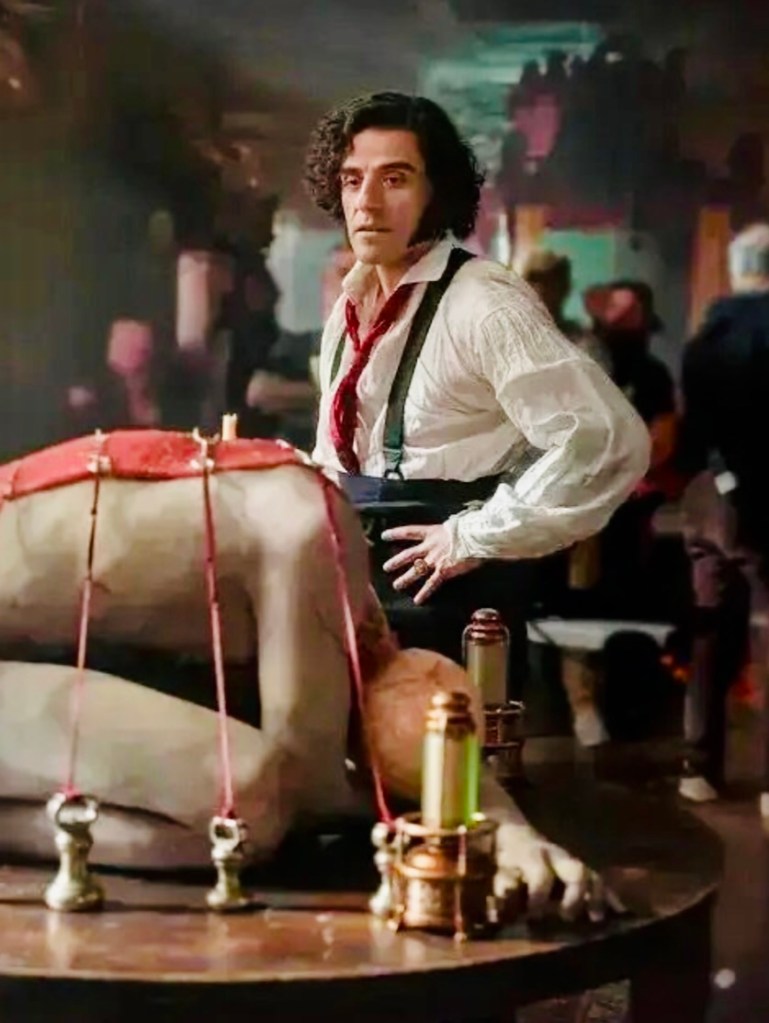
And even more gruesome are the practical shots of scientific body-horror shown as Victor is assembling his creation – the floor of his laboratory resembling an abattoir, as it is soaked in blood and littered with pieces of human meat. Never before have we been provided with such a rich back story for Victor Frankenstein and the build up to his ultimate experiment. It is at the hour mark of its two and a half hour run-time that The Creature is finally brought to life.
Although gigantic and muscular in structure, this version has a childlike quality, instantly looking to Victor as a father figure. With fatherhood being a vital theme in Del Toro’s epic adaptation. But Victor’s patience soon begins to wear thin with his creation, mimicking the treatment by his own father perhaps. Elizabeth however has an instant affinity with The Creature, and she dislikes the fact that Victor keeps it chained in the laboratory’s basement. “He doesn’t know any better,” Victor reasons. “But you do,” she replies.

It is she who takes on the role of mother, of teacher. The two growing close as she feels an immense compassion, while Victor continues to grow displeased with his experiment, as The Creature does not have the intellect he intended. “Only monsters play God,” Elizabeth tells him with distain. Victor then plots to kill The Creature and all trace of his work by setting the laboratory alight.
Back in the present, The Creature bursts in on Victor recounting his tale to the ships captain, and the back-story narrative now switches to The Creature’s prospective as he begins to tell his own. He uses his strength out of sheer desperation, and manages to escape the burning laboratory. He is washed away by the ocean, eventually finding himself beached on rocks further along the bay, before he begins wandering through the woods.

As with Branagh’s 1994 movie, The Creature becomes The Spirit of the Forest to a family as he hides out in their barn, learning what it means to be human while building them gifts as they sleep. For a moment in time, he is at peace with his existence. However when wolves attack the farm, The Creature is forced to learn about the true nature of violence. Before beginning his vengeful search for Victor after finding himself alone once more.
Guillermo Del Toro has not only leaned heavily on Mary Shelley’s original source material, but has also taken inspiration from the numerous adaptations filmed over the last century. He crafts a version of Frankenstein which lovingly pays homage to everything that has come before, brought together with his own creative flair as a film-maker, as well as a sizeable budget allowing to bring his true vision to fruition. In doing so he has created his own masterpiece, and an emotional Horror story which deserves to be considered a modern classic. KZ
Words by Mark T. Bates

https://amzn.eu/d/6cGqObO
Love Horror Movies !?
Enjoy Horror Fiction !?
Check out the short stories in our Horror series:
‘The Curious Dark (Vol.1)’
‘The Curious Dark (Vol.1)’ – by Mark T. Bates
 kult-zilla.com
Leave a comment