



https://amzn.eu/d/95eJPQ3
🔥🔥🔥🔥🔥🔥
“I have seen the future of Horror … his name is Clive Barker.” – Stephen King (1985)
In 1984, Liverpudlian playwright Clive Barker announced himself to the Horror literary world with the release of his first Books of Blood collection of short-stories. A bizarre mix of Dark Fantasy and Horror which was wildly unique and transgressive for the era. He then released his debut novel in 1985 – The Damnation Game – an intriguing Faustian tale, which was swiftly followed by his incredibly dark novella – The Hellbound Heart – in 1986.

But while his writing career was taking off like a rocket, the first couple of filmed adaptations of his work; Underworld (1985) and Rawhead Rex (1986) – which were both directed by George Pavlou – were not particularly well received by audiences, critics, or indeed Barker himself. Thus, the legend tells us, Barker decided to take matters into his own hands, by taking on the production as well as the directing of the next movie project based on his work. His reputation helped him acquire backing with New World Pictures, who provided a budget of around $1 million. And Hellraiser, based on The Hellbound Heart, went into production.
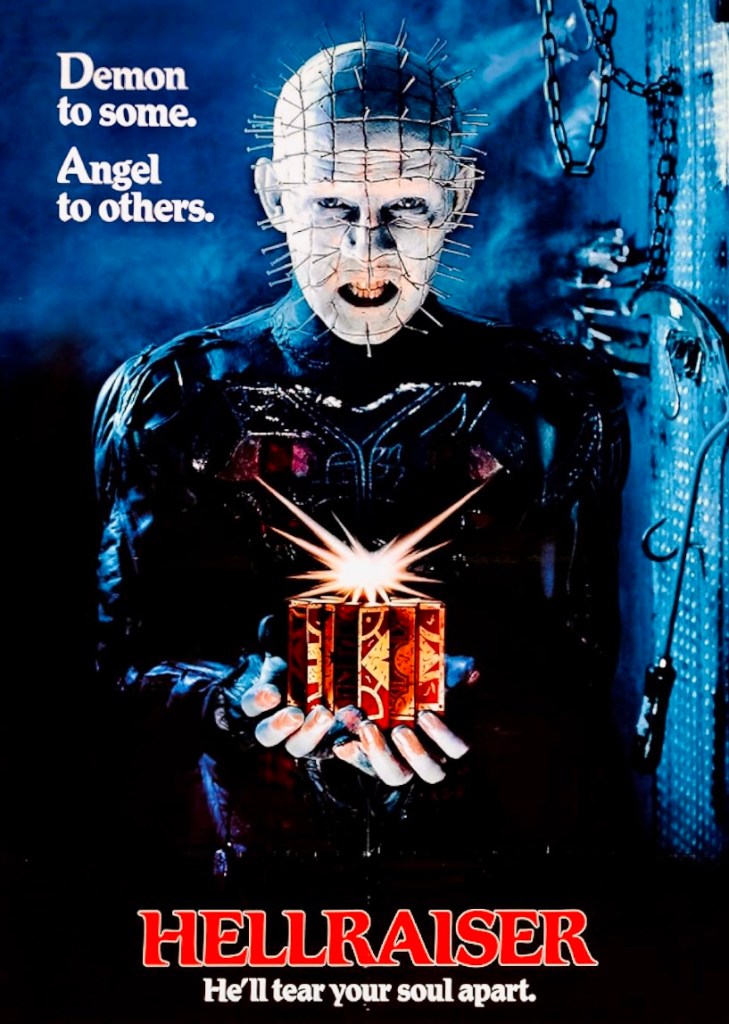
With Hellraiser (1987), Barker would manage to capitalise on the wildly fashionable Horror genre of the mid-80s, where franchises such as A Nightmare On Elm Street and Friday The 13th were printing money with movies that were made from relatively modest budgets. But his film was quite unlike anything that audiences had seen before. An early working title of Sadomasochists From Beyond The Grave aptly describes the rather bizarre story of a puzzle-box – known as the Lament Configuration – which opens an inter-dimensional portal to Hell, and unleashes grotesque demons named Cenobites into our world.

The dimension travelling demons arrive to claim the soul of whoever has opened the box, in order to torture them with unspeakable acts of deprivation which, for them, blur the lines between pleasure and pain. Visually, Barker creates visceral carnage in the opening scenes of Hellraiser, as chains and meathooks clatter above the mutilated body of Frank Cotton (Sean Chapman) – a depraved hedonist who acquires the puzzle-box and foolishly plays with the conduit in pursuit of the ultimate pleasure.
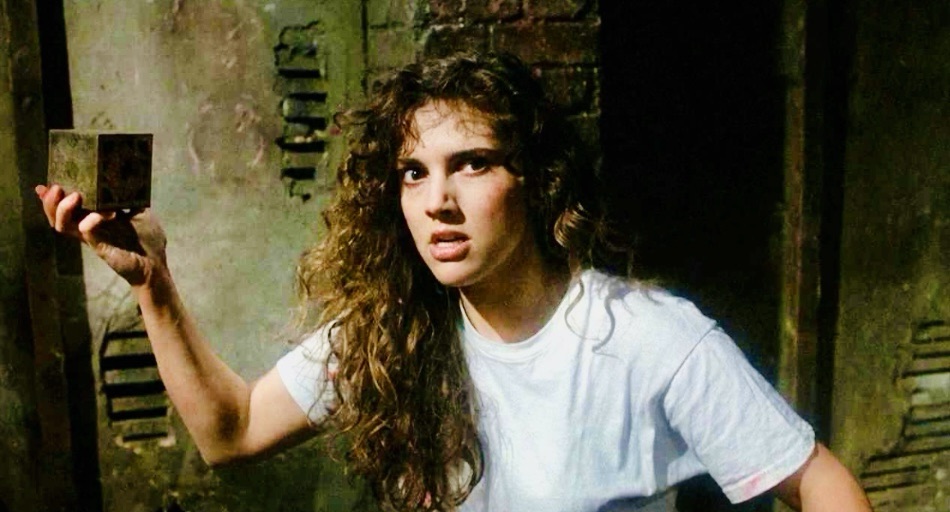
From here the film plays out as a sadistic and gory Body-Horror, as his former lover (and wife of his brother) Julia (Clare Higgins) restores Frank by delivering him the blood of men she picks up in bars. Their flesh regenerates his corpse after blood was accidentally first spilt in the attic where his body was claimed by the Cenobites. While Julia’s long-suffering husband Larry (Andrew Robinson) and his daughter Kirsty (Ashley Lawrence) are sucked into the world of Hellraiser, as the Cenobites come looking for the victim who has deceived them by finding a way to return to our realm from theirs.
Against all odds with its thoroughly dark, sinister, and often sexual tone … as well as its use of stomach turning gloopy practical F/X; Hellraiser would gross $30 million at the box-office. Making it an enormous financial success. And with the leader of the Cenobites (who would later come to be known as Pinhead) played by Doug Bradley, Barker had created a new iconic antagonist for the Horror genre. A sequel was inevitable. And although Barker would produce and oversee the project, the directing duties of Hellbound: Hellraiser II were passed to Tony Randel … with the movie arriving just one year later in 1988.

The story of Hellbound picks right up from the end of Hellraiser, and focuses on final girl Kirsty Cotton (with Ashley Lawrence reprising her role) – as she recovers from her horrific ordeal, in a psychiatric ward. However we are also shown a further flashback to British soldier Elliot Spencer (Doug Bradley) playing with the puzzle-box. We see him attacked with chains and hooks, his face and head cut as pins are hammered into his skull. And we realise we are watching the origins of Pinhead. With Barker and screenwriter Pete Atkins quick to capitalise on the iconic image, now making him the focal point of their series.

Whilst Kirsty tries to make sense of the events of the first film as she recovers in hospital, the sadistic Dr. Channard (Kenneth Cranham) takes a keen interest in her rambling stories of Hellish demons and the massacre of her family. Kirsty is particulary concerned when hearing that a mattress soaked in the blood of Julia has been recovered from their house, fearing that it could provide a vessel for her to return from the dead. Channard acquires the mattress and provides the blood sacrifice of a deranged patient from the bowels of his hospital, in what is a truly horrific scene of self-mutilation. A sacrifice which does indeed result in Julia (Clare Higgins) returning from beyond.
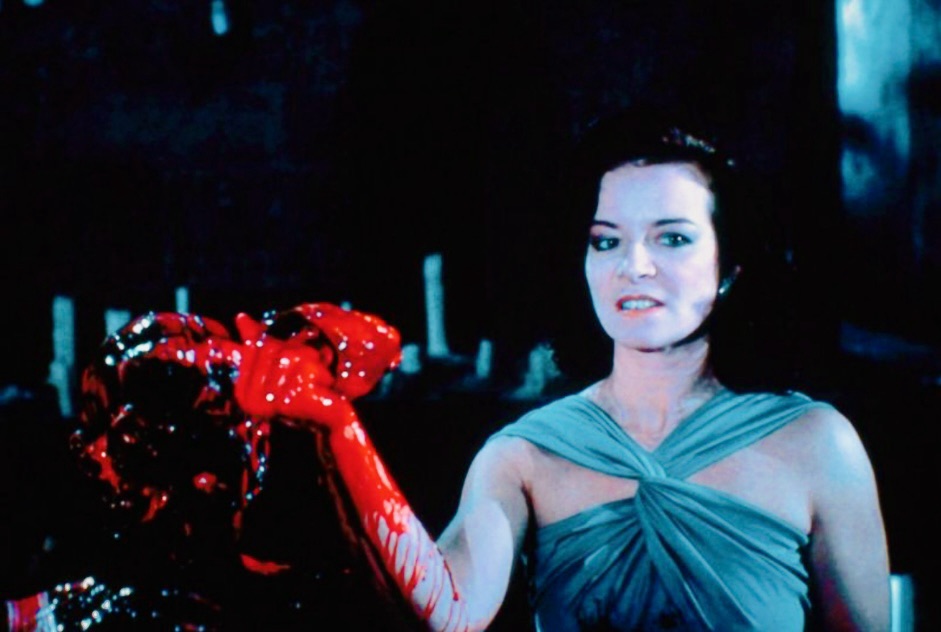
It becomes apparent that Channard has been obsessed with the legend of the puzzle-box for many years, and he and the initially skinless Julia form an unholy coupling, as she now resumes the role that Frank played in the first movie. In the psyche-ward, Kirsty has terrifying visions of her father who writes her a message in blood; I am in Hell, help me! She also meets the mysterious Tiffany (Imogen Boorman) – a mute girl who spends her time playing with puzzles. Dr. Channard uses Tiffany to open one of three puzzle boxes he has acquired over the years, once again summoning the Cenobites who leave open a gateway to the Hell from which they came from.
Cue a succession of nightmarish fever-dream visuals as Kirsty and Tiffany enter Hell’s labyrinth along with Julia, who shows she has become the embodiment of pure evil. Whilst Channard gets a whole lot more than he bargained for when he revived Julia, as he is double crossed and turned into a powerful Cenobite. Hellbound provides much more of a fantastical story than the orignal, aided by a larger budget in the region of $3 million – which saw a return of around $25 million worldwide – creating another financial success for Barker and New Line Cinema. Once again making the prospect of a further sequel an inevitability …

Hellraiser III: Hell On Earth (1992) was billed as Clive Barker presents … with Pete Atkins once again writing the script and Anthony Hickox (Waxwork / Warlock: The Armageddon) stepping into the director’s chair. At the beginning of the movie we meet J.P Monroe (Kevin Bernhardt), a young brash nightclub owner who purchases The Pillar of Souls; a strange and mystery statue which appeared at the end of Hellbound. A stature which just so happens to feature carvings of Pinhead and the other Cenobites on it, with their resting souls imprisoned within. The statue soon takes pride of place as an exotic art-piece in J.P’s club; The Boiler Room.
Meanwhile ambitious network TV reporter Joey Summerskill (Terry Farrell) begins investigating the origins of a man she witnesses die horrifically in front of her while she is in a hospital searching for a story. She watches as chains attached to his body rip him apart, before his head explodes. When the man is first wheeled into the hospital, a terrified young woman – Terri (Paula Marshall) – is with him. She runs from the scene, but not before telling Joey that they had come from The Boiler Room. Joey visits the club and leaves a card for Terri to call her. Terri does indeed call, then visits Joey at her home, where we learn the dead man had stolen a puzzle-box from the statue acquired by J.P in the moments prior to his death.

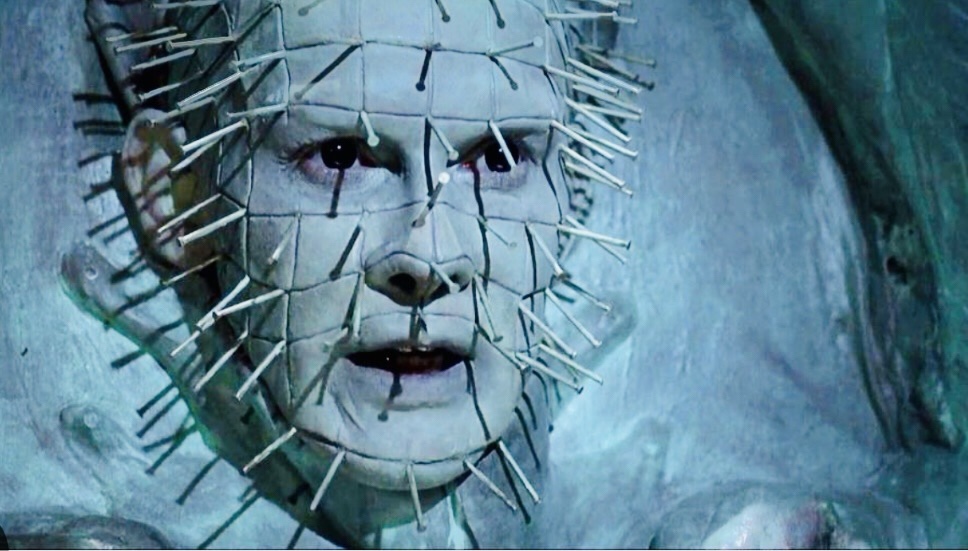
Inspecting the damaged statue, J.P is bitten by a rat which sprays his blood across the monument. He then watches mesmerised as his blood is absorbed into its structure. J.P moves the pillar from the club to his apartment, and when he takes a girl back for a spot of romance … Pinhead’s eyes open. During a post-coital row, J.P’s conquest stumbles close to the statue. Her body is covered in chains and her skin is ripped from her before she too is absorbed into the pillar … Pinhead is awoken! And he demands more sacrifices from J.P to provide him with the power to break free.
A highly memorable nightclub massacre eventually ensues, drawing in Joey who is in possession of the puzzle-box stolen from the statue. Pinhead demands the box from her, but she manages to flee. So he sends a whole new gang of Cenobites created from the onslaught to stalk and kill her – a rogues gallery of over-the-top, tongue-in-cheek demons. Hellraiser III stands out within the series of films for this change of tone. Although it is still just as gruesome as it’s predecessors, featuring all of the nasty practical F/X viewers had come to expect. Its $5 million budget allowed for a slicker look, and although it generated around $12 million – just about making it a financial success – it’s drop off from the first two films was clear.

But the series would inevitably return with Hellraiser IV: Bloodline in 1996. A release which would mark the final Hellraiser film to be released theatrically. Presented as an anthology of sorts, three stories are spread over very distinct timelines. But the tales are linked by a deeper exploration into the lore of the puzzle-box, it’s creator and his bloodline. The movie opens on a space station in 2127, where a scientist – Dr. Merchant (Bruce Ramsey – Alive) – is experimenting with the Lamont Configuration, his motives initially unclear. A group of mercenaries board the station and imprison Merchant; who explains his intention is to close the gate to hell once and for all.

He begins telling the origin story of the box, which was built by his ancestor; the great 18th century French toy-maker – Phillip LeMarchand. The toy-maker had been commissioned to create the box by a mysterious benefactor, an occultist by the name of Duc de L’isle (Mickey Cottrell). Phillip visits the home of de L’isle to deliver his work and discovers a sadistic soirée. The puzzle-box is then used as part of an unholy ritual, in which a murdered young woman Angelique (Valentina Vargas) is brought back from the dead. But she has returned. possessed by a demon. Phillip is told that it is because of the power of his puzzle-box that demons will now walk the earth … and subsequently his bloodline will be forever cursed.

The film jumps forward to the middle segment, where in the present day; John, the toy-maker’s ancestor is a renowned architect. Angelique still wanders the Earth, and recognises the toy-maker’s ancestor on a magazine cover. She visits him at an award ceremony where he has been honoured for a building design that resembles the mechanics of the Lament Configuration. When he see’s Angelique, he has flashbacks to the horrors that his ancestor witnessed in France. The femme-fatale Angelique seduces a man with the original puzzle-box, bringing forth Pinhead who refers to her as “princess” – and it transpires they are familiar with each other from her time spent as a demon in Hell.
She then turns her attentions to seducing John, explaining that they are linked by destiny, and he dreams of making love to her. Meanwhile Pinhead shows Angelique the power he has on Earth in a particularly gruesome scene of Body-Horror – as he conjoins two security-guard brothers in the middle of one Iron Maiden-style torture mask. The puzzle-box is eventually destroyed banishing Pinhead back to Hell, and the movie comes full circle as we return to the futuristic space-station. Here we learn that Dr. Merchant has already summoned Pinhead, the Cenobite version of Angelique, and the now grotesque twin brothers.

Bloodline is certainly a convoluted entry in the Hellraiser series, but neatly adds to the already complex lore that Clive Barker first created in The Hellbound Heart … and it certainly isn’t without its charm. The historical French segment is particularly enjoyable and could have worked even better if it were fleshed out somewhat. In fact such were the cuts and studio tampering on the film, that director Kevin Yagher successfully had his name removed form the credits – with direction instead credited to the controversial Alan Smithee pseudonym.
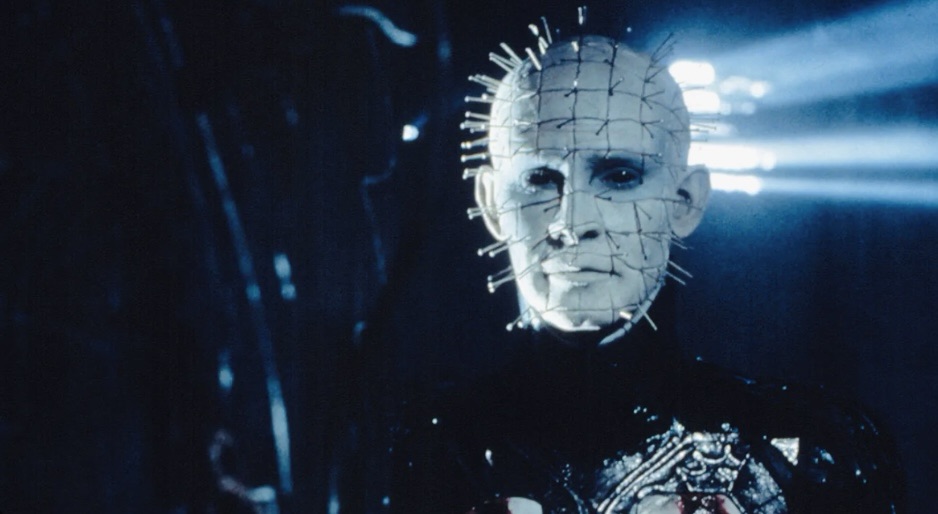
Bloodline pulled in around $9 million at the box office, and was largely panned by both critics and moviegoers alike. But while it’s cinematic life would end here, the Hellraiser legacy would continue with a number of low budget straight-to-video nasties. Six further movies in fact were released between 2000 – 2018. Films generally throught to be low-budget trash. But there has always been the appetite to return the series to its former glory, and a reboot with a $16 million budget by way of Hulu would arrive with; Hellraiser (2022). And its moderate success in bringing the series to a new generation tells us that this probably won’t be the last we see of the Cenobites, or this thoroughly strange world originally created by the Horror-master; Clive Barker. KZ
Words by Mark T. Bates

https://amzn.eu/d/95eJPQ3
Love Horror movies !? Enjoy Horror Fiction !?
Check out our series of short stories …
‘The Curious Dark (Vol.1)’
‘The Curious Dark (Vol.1)’ – by Mark T. Bates
 kult-zilla.com
Leave a comment