


https://amzn.eu/d/b5TAnqi
“Everything has a price, and every price must be paid.”
Witchcraft For Wayward Girls is the latest novel from the New York based Grady Hendrix, a novelist who has also seen his books sit on the New York Times Best Sellers List from time to time. Hendrix has often been tagged with writing ‘Gateway-Horror’ – accessible Horror that appeals to a host of readers including the YA market. And he has experienced some considerable success with a host of previous novels including Horrorstör (2014), My Best Friend’s Exorcism (2016), We Sold Our Souls (2018), and most recently; How To Sell A Haunted House (2023).

And Witchcraft For Wayward Girls follows suit. A toe dipped into the ocean of the Horror genre, with a story focusing on a snapshot in time of the lives of a gang of teenage girls – thrown together in the most difficult of circumstances. Hendrix was inspired to write this story after discovering that around fifty years ago, two close relatives of his had spent time in homes for young un-married pregnant woman. Maternity homes where young females were nurtured during their final stages of pregnancy, sent by their families to have their illegitimate children in secret, before signing away their babies for adoption and returning to their normal lives as if nothing had ever happened.
In Hendrix’s fictional tale we follow one such young female. 15-year-old Fern, farmed off to the Wellwood Home For Girls in 1970, by her disappointed and incredibly distant father. Her father symbolises the conservative society of the time, and Hendrix is keen to make the generational divide between him and his daughter clear, as well as the division that the teenage generation felt from society in that changing era. And due to her condition Fern is an outcast from both society and her family. Forced into isolation against her will to deal with the problem she has caused for herself, and the shame she has imposed on her parents.
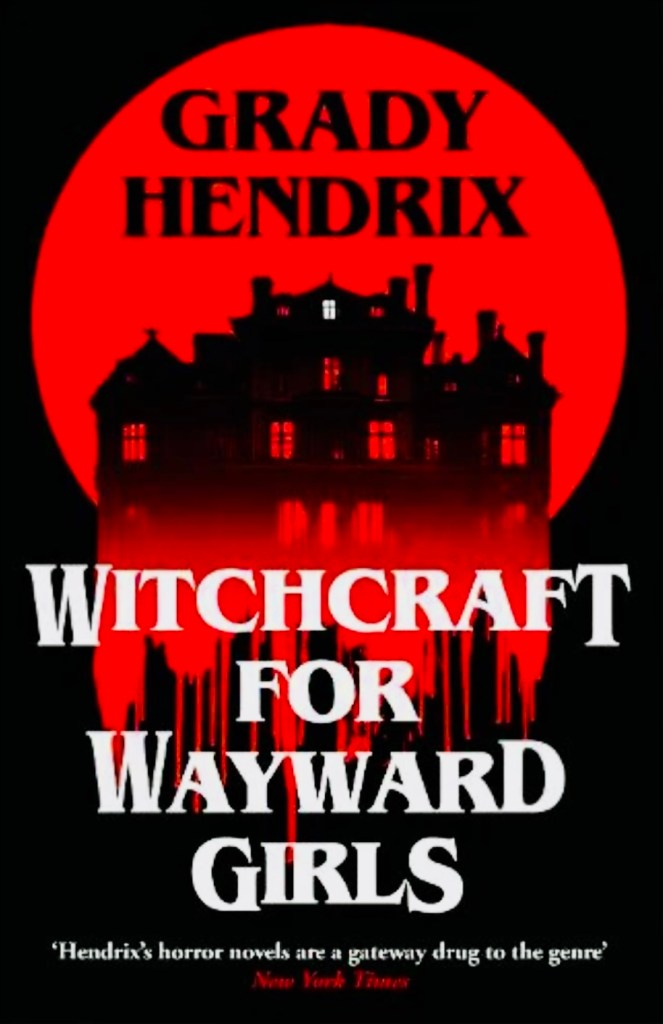
Hendrix litters the early stages of his story with an abundance of pop-culture references to help the reader ease into the time period, and he sets the scene of the story by spending time building an engaging world for the characters, that is incredibly easy for the reader to immerse themselves in. The narrative is supplied in somewhat of a slow-burn style, with Hendrix taking nearly a quarter of the 475 page length to build towards what the majority of readers will have come here for … witchcraft!
Hendrix is careful to make us sympathise with Fern, to really feel the isolation she feels when first left at the home. The loneliness she feels and the fear she has for her future and that of her unborn child. In conforming to what her parents – the conservative society – are telling her to do. She is essentially giving up a part of herself, her choices, her freedom, and her future. In the girls she becomes friends with she finds kindred spirits. And in the old librarian they meet who provides them with a mysterious book to read, they find a mentor. The first adult since arriving at Wellwood who doesn’t look through them … and that is exciting.
The girls offer each other a family, even if they know it is only going to be for a short while. And the witch and her covern offer an extended family along with dark temptations. In the context of this story, the witches are a metaphor for rebellion against the society that is damning Fern and her new friends. While the idea of the covern and their magic represents that of the hippy-movement of the time, of drug taking and the corruption of youth. But the witches also represent strong-independent women in general to the young characters, putting themselves forwards as role models of sorts.
Hendrix puts the reader into the place of Fern with an impressive ease, we want her to find a way out of the adoption-machine that is the Wayward House, we want her to take control of her own destiny. And although the Horror is sparsely used within the story, Hendrix does at times take the reader down some darker paths. Touching on themes including sexual abuse, body-dysmorphia, and declining mental health – while also providing a handful of graphic descriptive scenes of self-mutilation and child-birth. In the final act, as the story accelerates to its rather poignant conclusion, Hendrix also crafts some wonderful scenes of tension. Scenes that make certain chapters impossible to put down half-way through! KZ
“It’s not a perfect world, but it’s the only one we’ve got.”
Words by Mark Bates

https://amzn.eu/d/b5TAnqi
 kult-zilla.com
Leave a comment